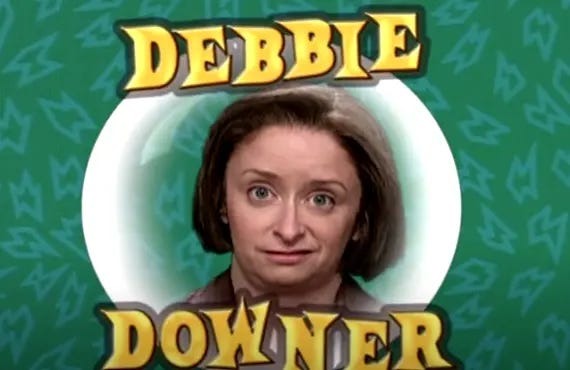
Parshat Ha’azinu: Yom Kippur – Don’t Be a Debbie Downer
One of the most moving and central prayers on both Rosh HaShana and Yom Kippur is Une’taneh Tokef. It is a highlight of the service as it defines the meaning of the High Holidays more than any other prayer:
On Rosh Hashanah will be inscribed and on Yom Kippur will be sealed – how many will pass from the earth and how many will be created. Who will live and who will die…who will rest and who will wander, who will live in harmony and who will be agitated, who will enjoy tranquility and who will suffer, who will be impoverished and who will be enriched, who will suffer degradation and who will be exalted.
At issue with the “written and sealed on Rosh HaShana/Yom Kippur” duet is that it sounds like our year is set and that nothing can be changed. To counter this we turn to the self-same prayer where we loudly proclaim its crescendo, “But Repentance, Prayer and Tzedaka can avert any evil decree.” Whatever heavenly decrees might be against us, it is ultimately in our hands and within our power to make our year a better one through Teshuva, Tefillah and Tzedaka.
While this prayer is a very stirring part of the service, its origins have cast a very negative light upon it. Many Machzorim (High Holiday prayer books) claim it came from the story of the 11th century Rabbi Amnon of Mainz who happened to be quite close with the Bishop of his city. As was often the case in medieval Europe, Christians tried to convert Jews and the Bishop made such an offer to Rabbi Amnon. The Rabbi said that he would think about it for three days as a delay tactic while he thought of a way out of this quandary. But he soon regretted his response, fearing it gave the Bishop the wrong idea. Namely that he was serious and contemplating switching teams.
He spent the three days in prayer and fasting and didn’t return, whereupon the Bishop sent his henchmen to fetch Rabbi Amnon. The Rabbi requested that his tongue be cut out to atone for his verbal misrepresentation but instead, the Bishop ordered his hands and legs amputated – limb by limb – as punishment for not obeying his word to return and for refusing to convert. His limbless torso was then taken to the synagogue on Rosh HaShana where he spontaneously chanted this prayer and then expired soon after.
The story is upsetting to say the least and not an image we necessarily want stuck in our brain on the holiday. But I am about to remedy that for you.
In the Machzor put out by the late Chief Rabbi of Britain, Lord Jonathan Sacks, he notes that there is ample evidence that Une’taneh Tokef’s origins were not necessarily tied to this horrific event, if such an event occurred at all. There are a few pieces of evidence supporting this, one of them being that this prayer was discovered in the Cairo Genizah and would indicate that not only was it from hundreds of years earlier than claimed, but that it came from Israel and not Europe. (The Cairo Genizah is a collection of 300,000 Jewish manuscript fragments that were found in the genizah/storeroom of the Ben Ezra Synagogue in Fustat or Old Cairo and are dated as early as 870 C.E.)
I for one was quite relieved to discover this because I have always felt that the purported background to this prayer had created a black cloud over it. The revelation of this alternative and more likely source is an important lesson in and of itself for Yom Kippur. Namely, don’t be negative when you don’t have to! Go with the more plausible positive scenario than the less likely negative one.
Associations are very important and overly negative ones can caste a dark shadow. I sometimes think that the Galut (the Exile) has gotten the best of us Jews and we too often take the negative approach when it isn’t necessary to do so.
Whenever I hear of Jewish leaders, rabbis and others talking about “the dangerous and difficult times we live in” I cringe. Difficult? In comparison to what? Europe of 150 years ago, 500 years ago, or any other time Jews have lived in the last two thousand years? We live better today as a Jewish nation than any other time except maybe Solomon’s, recent upticks in antisemitism notwithstanding. Being a Jew in the 21st century is certainly easier than at any time in the last two millennia. One has ample time to devote to study of Torah which is just a click away on the computer. Or how about visiting Israel in a mere half day, or less? You know what our great-grandparents would have done to be able to get to our ancestral homeland so easily? And not just that, but to find a bustling modern nation, not just a pile of rubble and dust, as it was for so many centuries before 1948.
There is no question that so many haters have come out of the closet since that horrible day of October 7th. And it would be very easy to wallow in gloom and doom scenarios for Israel and Jewish people elsewhere since then. But the fact of the matter is that if you study Jewish history you would discover that there were times when there were literally a hundred October 7ths that took place in some countries and communities.
Such as the Chmielnicki Massacres of 1648-1656 across Ukraine where hundreds of communities suffered pogroms. Or the The Rintfleisch pogroms in 1298 where 146 communities were destroyed and tens of thousands of Jews were killed in Germany. And needless to say we don’t even have to mention the horrific fate of European Jewry a mere 75 plus years ago. There was no IDF to stop those tragedies in their tracks back then.
The simple fact of the matter is that whatever difficulties we Jewish people are facing today, in comparison to most times and places in the last two thousand years, we are living in a Golden age for our people.
So this Yom Kippur, let us collectively do teshuva on the negative attitudes that we have allowed to seep into our lives – both on a personal and on a national scale – and that brings us down from the greatness that is our destiny. I am not saying we should let our guard down, especially when it comes to Israel’s security, or that we should see everything with rose coloured glasses. But let’s make a commitment to view our lives and our people in a more positive light, which in fact is a truer reflection of our situation today. And while Rabbi Amnon and so many others may have indeed suffered throughout the ages, let’s show God that all we want from Him is Life, Joy and Goodness for His people and for the world.
It starts by focusing on the abundant Life, Joy and Goodness that He is giving us right now.
Here come bad news talking this and that
Well give me all you got and don’t hold it back
Well I should probably warn you I’ll be just fine
No offense to you, don’t waste your time
Here’s why
Because I’m happy
-Pharrell Williams