
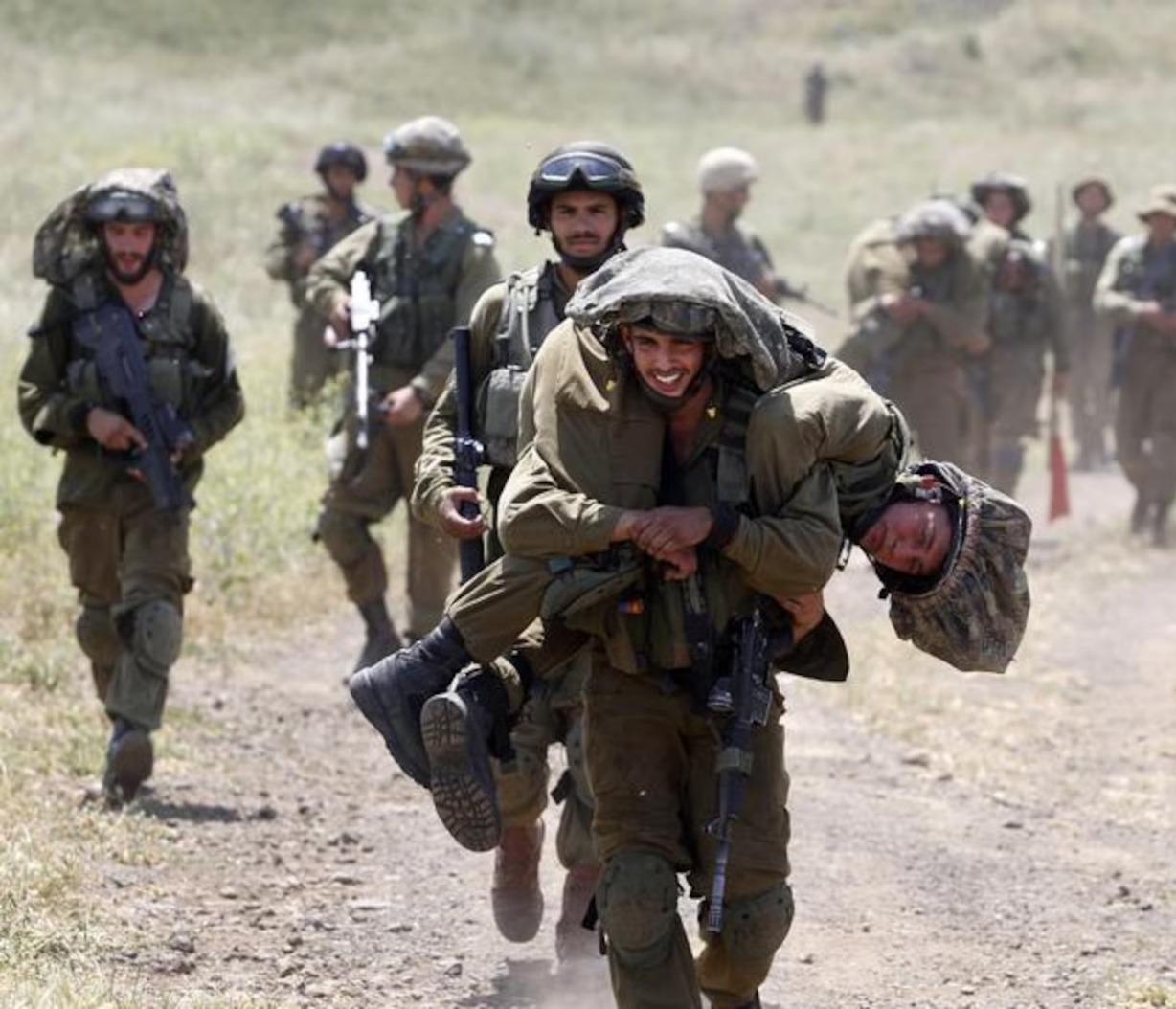
Parshat Ki Tavo: He Ain’t Heavy, He’s My Brother
This week’s parsha continues the speech that Moshe delivered to the Israelites before he passed on. We are pretty much at the end of that lengthy discourse. This week we read of a very dramatic event that will take place as soon as the Israelites enter into the Land of Israel. Half the nation will stand on one mountain, the other half on another and in the valley between them will be the Aron HaKodesh – the Ark of the Covenant along with the Elders, the Priests and the tribe of Levi. A series of 12 Blessings and Curses are to be pronounced to which the nation will acknowledge each by answering “Amen” in unison.
The commentaries look for a common thread to the pronouncements. They include people who create idols in secret, one who moves the boundary of a neighbour, thereby stealing his property. Giving bad advice to someone who doesn’t know better, thus “causing the blind to go astray” and one who takes advantage of the weak such as an orphan or widow. They note that these curses are related to transgressions that can be done secretly.
One might think that they could get away with doing the sin without anyone knowing about it. This public ceremony is to dispel that notion and it’s done in such a theatrical way to show that nothing is ultimately concealed from God who sees all. Also these wrongs may very well be visible to your neighbor even though you may think otherwise. We are very attuned to this in our time where cameras recording our actions are ubiquitous, whether we are aware of them or not.
The event is connected to the beginning of next week’s Torah portion where Moshe adds a new wrinkle into the covenant between God and Israel. And that is the covenant within the Jewish people itself which emphasizes that we are all connected to and responsible for one another. We cannot overlook the faults of another and further, must assist them in their time of need.
Being there for each other was very easy to accomplish when the Israelites were travelling for 40 years in the confined setting of the desert. But now that they are about to go their separate and tribal ways once they settle the Land of Israel, this becomes a whole new challenge. Hence Moshe drives the point home that each Jew must care for and be concerned about his or her brothers and sisters. At this juncture, they formally seal the contract of ערבות Arvut whereby each and every Jew acts as a guarantor to one another. Just like a guarantor on a loan, I am responsible for your obligations and if you fail to pay I will be there to pick up the slack and you in turn would do the same for me.
Indeed this has been one of the hallmarks of our people throughout the ages. If part of the Jewish community of New York or Israel or anywhere in the world is in danger, if one Jew suffers an anti-Semitic or terrorist attack, we all feel it and rush to aid in any way that we can. It is something deeply embedded into the soul and psyche of our nation and has been for thousands of years. It is the complete opposite of the sentiment shared by Cain who murdered his brother and when confronted by God about it answered, “Am I my brother’s keeper?” To that question, we Jewish people have resoundingly and loudly answered, “Yes, I am my brother’s keeper! I have been and always will be.”
At the other end of the spectrum, and still subscribing to the sad and tragic behavior of Cain, are many in the Arab world who don’t give a damn about their brothers and sisters. While they are all too happy to give lip service for the cause of the Palestinians, their silence about other, larger human tragedies among other Muslims in the region or among their co-religionists elsewhere exposes their hypocrisy.
It is well documented that half a million Syrians were butchered by the Assad regime and millions more lost their homes and were internally displaced. Yet that never was a focus in the Arab world, nor was the recent killings of tens of thousands by the Iranian security forces against innocent protestors to the regime. Similarly in the Christian world, Christians are being slaughtered in Africa and elsewhere, but the Pope – the one man you would think would have a strong sympathy and care for his co-religionists – seems to spend an inordinate among of time, words and energy on the Palestinians and has little to say for the slaughter of his fellow Christians in Nigeria.
The advocacy group Open Doors International reports that Nigeria routinely accounts for the vast majority of Christians killed for their faith globally. Local rights organizations estimate that thousands are killed annually, alongside widespread abductions of clergy and villagers.
One of the greatest examples of this dichotomy between the Cain-like Arab world and the Arvut “I am my brother’s keeper” Jewish world is with the very creation of the State of Israel. During that time about the same number of Jews became refugees from Arab nations as Palestinians did from Israel – about 700,000. Yet there is no Jewish refugee issue and there never was one. Yet somehow there still remains a Palestinian refugee crisis, perpetually for close to eight decades.
Why? Because thousands of years ago Moshe made us promise we would look out for one another. That we would take care of each other. That we are guarantors for one another.
It is a great shame that much of the world refuses to take note of the example of the Jewish people and how we come to the aid of our brothers and sisters. Once again we Jewish people could have been a Light Unto Nations and set a standard for others. We could have been, but in the case of both the Muslim and in even parts of the Christian world, their hatred too often blinds them from seeing that Light. Hopefully one day they will.
The road is long
With many a winding turn
That leads us to who knows where
Who knows where
But I’m strong
Strong enough to carry him
He ain’t heavy
He’s my brother
-The Hollies