Parshat Matot/Masei: They Just Love a Good Funeral
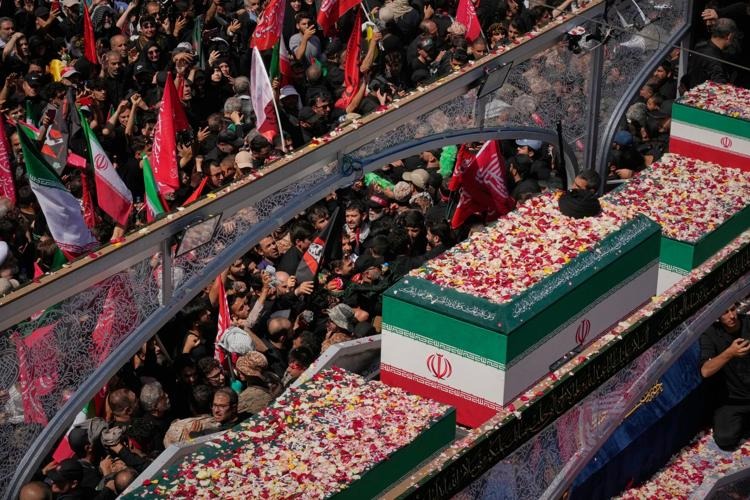
This week we were treated to the spectacle of the Iranian state funeral of Ali Khamenei attended by hundreds of thousands throughout the nation. Some in the media gushed at the large number of mourners participating in the week-long event. It is a declaration to the world, they tell us, that Iran wants to exhibit their continued might and power despite the severe military setbacks and damage to their ambitions of securing a nuclear weapon. We are even told by some that they have emerged as the victors. You don’t have to be a sleuth to know that anything that will make Trump (and by extension, Netanyahu) look bad is certainly an underlying motivation behind the coverage.
Of course, ever present at such vast gatherings are the requisite chants of “Death to America” and “Death to Israel”. Death, Death, Death. They just looooove talking about Death. Western pop artists and bands can’t stop singing about Love, Love and Love. But the Arab world cannot stop chanting about Death, Death and Death.
This culture of Death that permeates parts of the Muslim world, particularly in Arab nations, expresses itself in many ways. We have all seen the interviews of the chubby mothers of Gaza, covered from head to toe in their Chadors, shepping nachas that their child is a Shahid – a Martyr. When Jewish mothers get together they talk about their child the Doctor, the Lawyer, the Nursing-home owner. Not so their Muslim counterparts. When they get together for Mahjong, they brag about how their child was blown up, shot or bombed and is now in heaven.
And btw, it isn’t just in Muslim society where Death is venerated. Walk into Westminster Abby and you will be greeted by a graveyard of sorts. Over 3300 notable figures are buried beneath its floors including 30 monarchs. This is a pretty common practice in other major British churches and cathedrals. The dead buried right there in the church.
We Jews find all of this very foreign to say the least. Our favourite expression is LeChaim – To Life! On Rosh HaShana and Yom Kippur – the holiest days in the Jewish calendar – all we talk and pray about is having another year of life. Israelis, and Jews all over, now take leave of each other with the greeting of Besorot Tovot – Only Good News – even when leaving a shiva house.
So how exactly did this divergence in focus of Life versus Death come about? Why don’t we Jews glorify Death the same way? There are a couple of reasons, the most obvious one being that our Torah has very little talk of the afterlife. It is never explicitly mentioned and at best hinted to with verses mentioning that Biblical figures such as Moshe or Avraham were “gathered unto his people.” Yes a belief in the afterlife is an integral part of Judaism and the Talmud and other traditions write at length about it. But it is not our focus. Our focus is the here and now. Making this world a Utopia, as opposed to living for a future one elsewhere.
But there is another reason to Judaism’s focus on Life and not Death and it has to do with one of the more obscure bits of the Torah. Tumah and Tahara figure prominently in the Torah, especially in the Book of Leviticus which describes the Mishkan/Temple services. Someone in a state of Tumah, be it the Kohen who serves there or a visitor, must be in a state of Tahara to be allowed in the Beit HaMikdash/Temple grounds. Tumah and Tahara are translated as Impure and Pure respectively but this is a confusion.
We tend to think of Pure as something good, wholesome and desirable while Impure is bad, unclean and tainted. Tumah/Tahara have nothing to do with good or bad, right or wrong, pure or tainted. It is a completely independent system from good/evil or Truth/Falsehood. The sole criteria to define if one is in a state of Tumah or Tahara is Death. Come in contact with the Dead – directly or even indirectly – and you are Tumah and you must undergo a process culminating in going to a Mikvah to become Tahor.
Today’s most common expressions of this Tumah/Tahara system is a Kohen who is not allowed in a cemetery unless attending the funeral of an immediate family member. Or a women who has had her period because there was the potential for life that was not actualized and hence a death on some level.
The fact that Judaism demands that a Kohen or anyone visiting the Temple, the holiest place on earth where God is most manifest, must avoid any connection to Death sends a powerful message about our relationship to God and our relationship to Life itself. Whereas it is true that during life’s difficult times people turn to God, the Torah views this as a lesser expression of our relationship with Him. The greater connection with God is in moments of joy, happiness and life, and not in sadness, grief and death. Hence we don’t want anybody connected to Death in the Beit HaMikdash. They are banned from there until they purify themselves from this deathly state.
Death and God don’t belong together. God Himself being Infinite has no beginning and no end, and hence Death is in no way truly tied and associated with His essence. Life is where we see the greatest expression of who and what God really is. God is more readily found in Life and not in Death. And that’s why the Kohen, being the servants and representatives of God, must avoid anything that smacks of Death. The Kohen must symbolize the highest relationship with God – one of happiness, joy and Life – and not the lesser one of grief, sadness and Death.
Similarly Jewish tradition teaches that a prophet could not reach a state of prophecy if he or she were unhappy or depressed. The Shechinah, the Divine Presence would not be available to the prophet unless he or she was filled with joy and happiness and often prophets would have musicians play for them to help them get in the right frame of mind for prophecy.
Nobody questions that Death is a fact of life and visits everyone at some point. But our highest and holiest connections with God are through Life. As such, our funerals are to show respect to the deceased and are not national events akin to the Super Bowl or World Cup where throngs come to cheer on their sick and deathly ideologies.
We hope and pray that one day the Arab Muslim world will join us in celebrating Life and not Death.
I laid him down in a grave in the sand
And he grabbed my arm with his dead man’s hand
He said: “I know I’m dead but I don’t wanna lie
In a grave out here where the coyote’s cry
I stared right into the endless void
And I ain’t going back if I got any choice
I know how to live, I don’t know how to die
And there ain’t no thrills in the afterlife”
-Lord Huron